
Showing posts with label field trip. Show all posts
Showing posts with label field trip. Show all posts
Monday, May 4, 2020
050420b
flames dance
above the dark shale slabs
campfire
who burns rocks in wilderness?
geology field trip

Wednesday, February 20, 2019
Paleontology Field Workshop for Teachers
Field Workshop — Paleontology of the Black Belt of Alabama
The Black Belt is a swath across central Alabama, named for its rich soil.
Last year, we focused on studying evidence of interactions among ancient organisms. This year, our focus will be using fossils to understand the stratigraphy, the layering of different kinds of rocks, in the field area.
Here are some photographs from past expeditions. We always find many kinds of fossils. In the past, these have included two pterosaurs, a brittle star, a mosasaur jaw, and a sea turtle shell.
At the bottom, is a registration form. We hope you will join us this coming fall!


Scenery not to be sneezed at.

A fish vertebra just lying on the ground waiting to be picked up.

Conversations in the field.

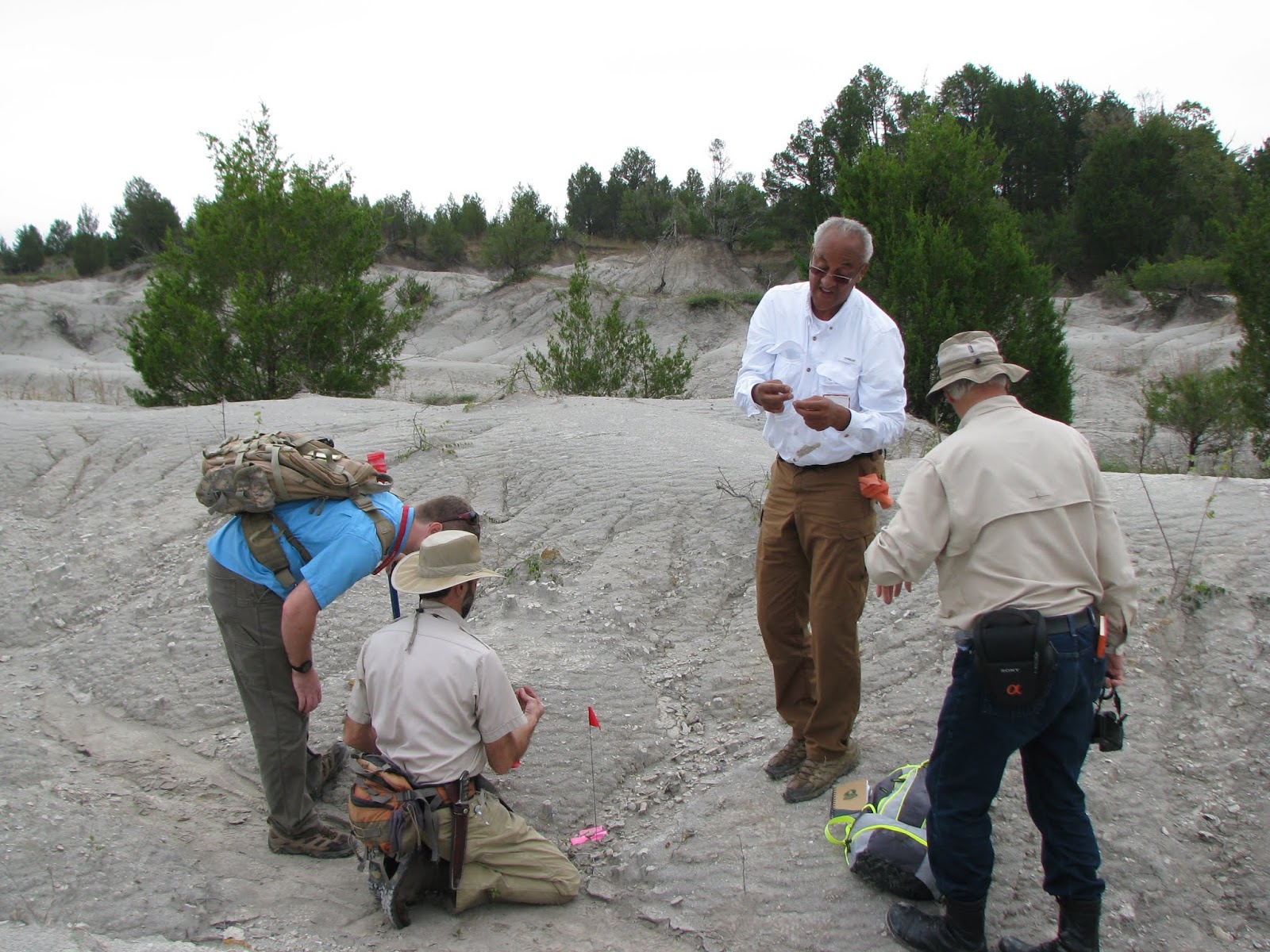
Conversations in the field.

Shark teeth from many species can be found here.

As well as many other things.

See!

All kinds of teeth.

Oysters and other kinds of shells are common.


All kinds of free publications for teachers to take home. Lunch and snacks are provided. We will help you identify the fossils that you find. You get to take them home, unless you find something truly remarkable. Those specimens go into the museum, with you listed as the collector.
Use this form to register, or email me at dkm@gsa.state.al.us

Wednesday, February 28, 2018
022818c
Lessons from Limestone field trip
Limestone is one of the most common rocks and you can teach almost anything about earth science using samples of limestone. Want to find out how? A great field trip is coming up this spring and you can get a $75 reimbursement for expenses if you are a K-14 teacher.
Here is the field trip announcement,, and I cannot say emphatically enough that it's going to be a very good field trip. I know the leaders and they are experienced and skilled educators. I guarantee any participants will learn a lot.
Teacher Grants Available for April 14 Geology Field Trip at SEGSA
K-14 Science Teachers in the Southeast are invited to apply by March 5 for funding to reimburse registration costs for the Saturday, April 14 NAGT-sponsored geology field trip, “Lessons From Limestone: How to Teach All Sciences with Limestone.” The trip follows the SEGSA meeting in Knoxville. To be eligible for reimbursement, you must both complete the application form and preregister for the trip by March 5.
The NAGT reimbursement following the trip will be $75. This covers $40 “Field Trip Only” registration for the April 12-13 Southeastern GSA meeting plus the $35 trip registration fee. (As a bonus, GSA lets K-12 teachers register for the full meeting for only an additional $5).
The link for the application is https://goo.gl/forms/lqPzFfpZUBE31aBj2 . Register for the meeting and trip at:
http://www.geosociety.org/GSA/Events/Section_Meetings/GSA/Sections/se/2018mtg/registration.aspx .
Michael Gibson (UT Martin) and Don Byerly (Emeritus UT Knoxville) will be leading the trip.
Participants will learn why limestone is ideal for teaching cross-disciplinary STEM subjects of biology, chemistry, and physics, along with history and culture. The trip will address Next Generation Science Standards related to chemical reactions, biological evolution, geochemical cycles, economic and environmental impact, and limestone’s historical importance to the fine arts.
Limestone, a nearly ubiquitous sedimentary rock, provides many lessons about Earth's systems (geosphere, hydrosphere, atmosphere, and biosphere), including the geochemical, hydrologic, and rock cycles. Additionally, limestone is ideal
for teaching cross-disciplinary STEM subjects of biology, chemistry, and physics, along with history and culture through its uses in society. It is a readily available commodity to teachers and students, thus is an ideal material for budget-strapped STEM education.
This field trip and accompanying materials address Next Generation Science Standards (NGSS) including: using fossils to develop concepts of paleoecology and evolution; using limestone to reconstruct ancient geography (including plate tectonics); the relevance of limestone to our society as a building stone, medical uses, and as a potential hazard associated with karst (caves and sinkholes), including where, how and why limestone forms. Five cross-disciplinary content standards will be addressed in the proposed guidebook paper and during field instruction: (1) enhancement of the understanding of chemical reactions, (2) biological evolution, (3) geochemical cycles, (4) economic and environmental societal impacts, and (5) historical importance and fine arts use of limestone to society.
Limestone formations are important archives of biotic and abiotic Earth history, provide valuable economic resources, and can sometimes be the cause of environmental hazards. Deposits around the world provide data for reconstructing global climate change and recreating Earth’s changing paleoecology throughout geologic time, including human history. As a sink for carbon, carbonate rocks are Earth’s main long-term antidote to global warming.
Friday, September 16, 2011

2010 fossil workshop


Andrew K. Rindsberg, University of West Alabama, one of the workshop leaders.
Fossil hunting on a Cretaceous chalk bald.
Subscribe to:
Posts (Atom)