Showing posts with label workshop. Show all posts

Thursday, March 18, 2021

031821c


Teacher workshop in paleontology, West Alabama, October, when the weather is perfect. Two photos of participants from previous years, collecting fossils  and learning by hands-on doing, followed by the registration form. If you have any questions, ask me here: dkm@gsa.state.al.us.


Tuesday, April 14, 2020

International Ichnofabric Workshop 16


Announcement, International Ichnofabric Workshop – 16

Convened by Andrew K. Rindsberg, Charles E. Savrda, David C. Kopaska-Merkel,
James P. Lamb

Livingston, Alabama, USA, May 23-29, 2021
Tentative field trip dates: May 18-22 and May 30-June 3
Twitter: @IIW161

Introduction — The International Ichnofabric Workshop began in 1990 as a conference devoted to the study of ichnofabric (sedimentary textures produced by bioturbation), but has since expanded to cover the full range of ichnologic topics. Research on ancient and modern traces, traces made by invertebrates, vertebrates, and plants, and traces of all places are equally welcome here.

This will be the first time since 2007 that the Workshop has been held in North America. Alabama is particularly well suited to host the workshop because of its diversity of trace fossil assemblages, found in rocks of ages from Cambrian through recent, allowing exciting field trips before, during, and after the conference. Tentative plans include seeing, in outcrop or in exhibits,

  • Cambrian Conasauga Formation Brooksella (sponge or trace fossil? You decide!)
  • Ordovician Chickamauga Limestone shallow-marine trace fossils
  • Mississippian Hartselle Sandstone and Parkwood Formation, shallow-marine to estuarine trace fossils including the crustacean resting trace Alph
  • Pennsylvanian Pottsville Formation estuarine vertebrate and invertebrate trace-fossil lagerstatten including the famous Steven C. Minkin Paleozoic Footprint Site (Union Chapel Mine)
  • Cretaceous Selma Group shallow-marine chalks and marls including the famous K-Pg boundary section at Moscow Landing, only a 30-minute drive from Livingston
  • Tertiary marine units in south Alabama

Call for submissions in the subject areas of…
  • general ichnology
  • modern traces (neoichnology)
  • vertebrate traces
  • invertebrate traces
  • ichnofabric
  • evolutionary aspects of ichnology
  • ichnostratigraphy
  • roots and other plant traces
  • ichnotaxonomy
  • pseudotraces and dubiotraces
  • microbially induced sedimentary structures (MISS)
  • ichnoentomology
  • paleobiogeography of trace fossils
  • form and function of trace fossils
  • history of ichnology
  • other
Venue and accommodation

The University of West Alabama

A relatively small university (2500 on-campus students) in a small city (Livingston, 3300 permanent residents)
Large, green campus
Committed to a policy of integration (about half African American)
UWA conference venues include auditorium, classrooms, and presentation area for posters
UWA lodging in student dorms
Dining at the UWA cafeteria, with an excursion to Touch of Home Bakery for lunch

Proposed field trips

Preconference field trip This will be charged separately from the conference fee, and the number of participants will be limited.

Day 1. Coastal Plain outcrops to be arranged

Day 2. Tuscaloosa, including Alabama Museum of Natural History (Pennsylvanian trace fossils) and Geological Survey of Alabama (cores, which might include Rodessa oyster biostromes; Smackover microcoprolites; Cretaceous cycles)

Day 3. Birmingham area, including Red Mountain and Parkwood formations; Pennsylvanian trackways etc. at McWane Science Center

Day 4. Minkin Site (Pennsylvanian Pottsville Formation)

Other field trips are possible: watch the Facebook page and website!

Mid-meeting field trip: This will be a one-day trip for all conference participants; weather and river levels permitting, we will stop at Moscow Landing and Gaineswood. The Local Committee will handle arrangements. The charge for this field trip will be included in the conference fee. We will come up with an alternate stop in case Moscow Landing is submerged.

Post-conference field trip: This will be charged separately from the conference fee, and the number of participants will be limited. Tony Martin and Sally Walker will take participants to coastal Georgia for a neoichnological extravaganza.

Meeting organization

A 5-day conference with 4 days reserved for talks (8 hours per day, 20 minutes per talk for about 100 participants) and one day for a mid-conference field trip. If we allot a room for poster presentations, then talks can be longer.

Organizing committee:
Andrew K. Rindsberg, University of West Alabama
Charles Savrda, Auburn University
David C. Kopaska-Merkel, Geological Survey of Alabama
Gabriela Mángano, University of Saskatchewan
James P. Lamb, Black Belt Museum
George Phillips, Mississippi Museum of Natural Science


Contact and information:

Andrew K. Rindsberg
Biological & Environmental Sciences
University of West Alabama
Livingston, Alabama 35470, USA
Phone +1 (205) 652-3416
Email arindsberg@uwa.edu

or

David C. Kopaska-Merkel
Geological Survey of Alabama
Tuscaloosa AL 35486-6999
Phone +1 (205) 247-3695
Email dkm@gsa.state.al.us

Thursday, January 30, 2020

013020c


I will be helping to lead a hands-on field workshop for K-12 science teachers on the subject of paleontology in West Alabama this coming October (see above). The subject this year is "Palaeoecology and Extreme Events." Participation is limited to 26.

Saturday, August 17, 2019

081719d


So the Alabama Science Teachers Association is meeting here in Tuscaloosa this year. Stop me if I have already told you about this. I decided to do a workshop about fossil footprints. Specifically, about trackways. Years ago I found this really cute activity where you step in paint, walk on paper, and then measure things, calculate other things, and, hopefully, realize that you can learn a lot from fossil footprints. I actually presented this to the same group years ago, but there is so much turnover among teachers (because they are treated like crap) that for most of them this would be a new experience. I recently discovered that the ASTA doesn't accept every single workshop proposal that is submitted, although I still think it's pretty close. But if they don't accept this one, it will be because the owner of the facility doesn't want people walking in paint on their floors. I have a plan for that, but I think if they say no they're going to say no before they hear about my plan. I guess I need to email the workshop organizer and make my pitch before it is too late! It involves using a large tarp and trusting teachers to be tidy. I can do that, can't I? Stay tuned.

Wednesday, February 20, 2019

Paleontology Field Workshop for Teachers


Field Workshop — Paleontology of the Black Belt of Alabama

The Geological Survey of Alabama, the University of West Alabama, Discovering Alabama, the Alabama Geological Society, and the Birmingham Paleontological Society have collaborated for 20 years on an annual one-day field workshop in paleontology. This workshop is specifically aimed at K-12 teachers, but other kinds of educators are welcome to participate. The workshop is held on a Tuesday in October (the dry season) at a privately owned large fossil-rich outcrop, to which we have access for this purpose.

The Black Belt is a swath across central Alabama, named for its rich soil.

Last year, we focused on studying evidence of interactions among ancient organisms. This year, our focus will be using fossils to understand the stratigraphy, the layering of different kinds of rocks, in the field area.

Here are some photographs from past expeditions. We always find many kinds of fossils. In the past, these have included two pterosaurs, a brittle star, a mosasaur jaw, and a sea turtle shell.

At the bottom, is a registration form. We hope you will join us this coming fall!


Scenery not to be sneezed at.


A fish vertebra just lying on the ground waiting to be picked up.


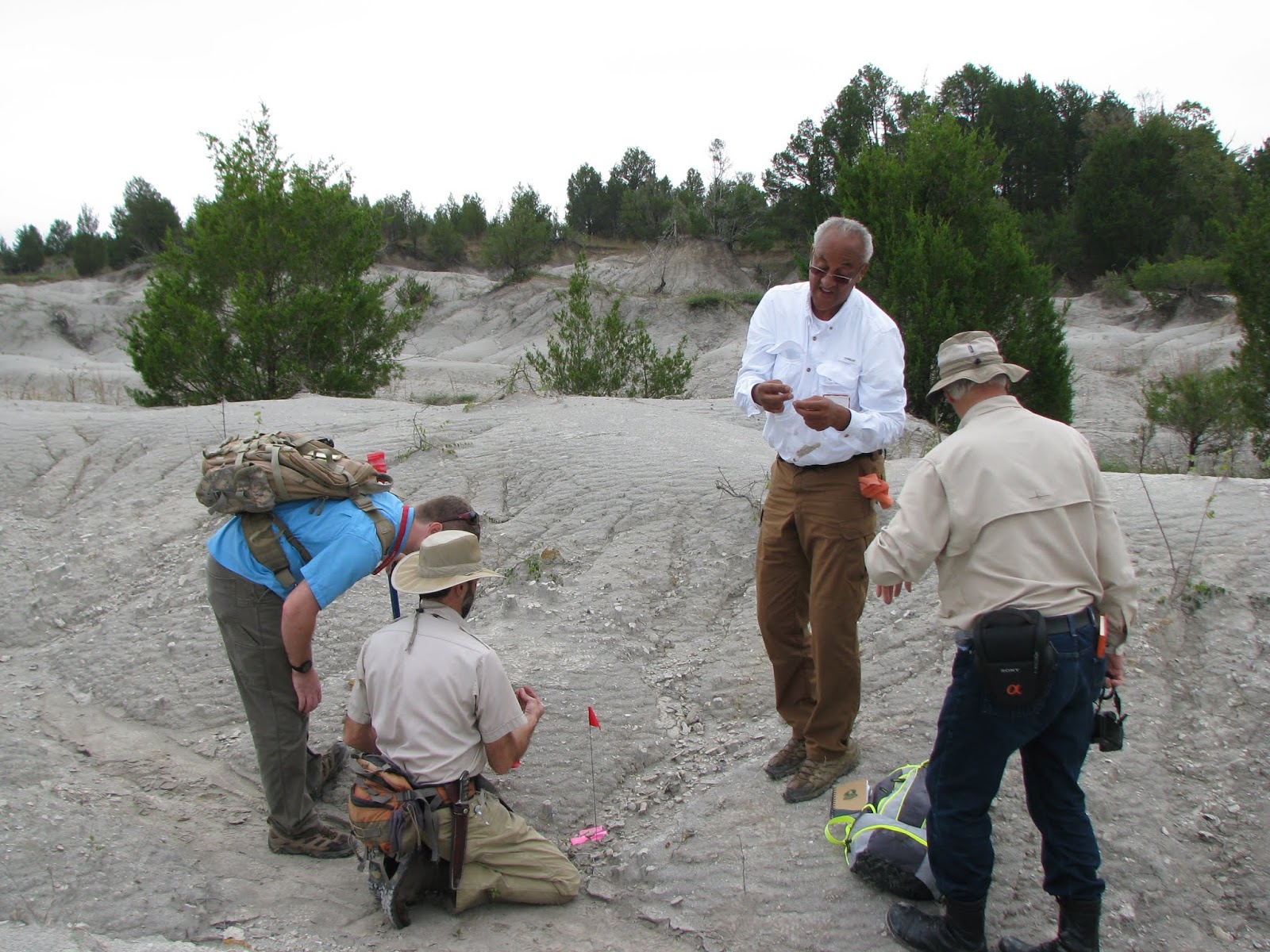
Conversations in the field.


Shark teeth from many species can be found here.


As well as many other things.


See!

All kinds of teeth.


Oysters and other kinds of shells are common.


All kinds of free publications for teachers to take home. Lunch and snacks are provided. We will help you identify the fossils that you find. You get to take them home, unless you find something truly remarkable. Those specimens go into the museum, with you listed as the collector.


Use this form to register, or email me at dkm@gsa.state.al.us

Wednesday, January 23, 2019

Fossils of the Black Belt 2018-2019


This workshop is held every year in October. Here are some photographs from 2018, taken by Vicki Lais. We were studying what fossils can tell us about interactions among organisms.


Fossils of the Black Belt 20 (2019)  — a Hands-on Field Workshop

The Geological Survey of Alabama and the University of West Alabama take the lead in presenting Fossils of the Black Belt 20, the latest in a long-running series of annual field paleontology workshops for teachers. This year's workshop will focus on biostratigraphy, the science of what fossils can tell us about the layering and ages of rocks. We will meet at Harrell Station, a productive Cretaceous fossil site on private land near Selma, Alabama. The workshop will take place on Tuesday, October 15, 2019. The cost is $28 for this one-day workshop. This includes lunch and a vast array of science-education goodies, including the famed book by Jim Lacefield, Lost Worlds in Alabama Rocks (a $25 value).

To register, please contact Dr. David Kopaska-Merkel, 205-247-3695, dkm@gsa.state.al.us.


Some of the free stuff.


The field site.


Fossil worm tubes, Hamulus.


A teacher, finding cool fossils.


Marking an important find for future excavation. We found a pterosaur!


A wide variety of mollusks here, especially, so many kinds of oysters.


Teeth are common: shark, fish, mosasaur.


A shark tooth.


This teacher is armed.


I missed the joke, but this teacher found more than anybody else.


A baby mosasaur jaw.


Fossil hunting.


Monday, October 15, 2018

101518c


No rain in the forecast for the workshop tomorrow. This is good, because the clayey soil becomes impossible to walk through if it's very wet. One ends up with huge clay boots. As it is, we can look forward to a day of discovery of many interesting fossils. And this is a site where almost every year somebody finds something truly remarkable, so we can hope for that too. In recent years we have found a pterosaur and a brittle star.


Monday, September 24, 2018

092418d


You are almost out of time to sign up for the October 16 paleontology workshop for teachers in West Alabama. This is a one-day field workshop, inexpensive, but valuable.. You will get lots of free stuff, including the fantastic book "Lost worlds in Alabama rocks." you will spend the day learning about interactions among fossil species, that we can learn about by looking at the fossils they leave behind. West Alabama is a great place to learn about this because Cretaceous fossils are diverse, abundant, and show many traces of their interactions.

Thursday, March 22, 2018

032218b


Paleontology workshop for teachers
Mainly aimed at K-12 teachers, but also appropriate for informal educators
October 16, 2018, West Alabama

Our focus this year is on evidence that fossils provide of interactions among organisms. What species grew on the shells of other species (or on other members of their own species). What animals drilled holes into other animals to make a living or to get dinner.. Which animals used their big strong teeth to bite into which other animals. And so on. We can learn a lot about the community by looking at clues preserved on the remains that we find.

And of course, participants get Lost Worlds in Alabama Rocks, one of the best books there is describing the fossils and rocks of a particular region so that anyone can understand. Many other publications and goodies will also be provided free.


You can use the registration form below, but email me if you have any problems with it.

Wednesday, October 18, 2017

101817d


So the fossil field workshop for teachers yesterday went really well. The weather was perfect. One of the teachers found a turtle femur. A fossil femur 82.5 million years old. People found fossils of sharks, fish, mosasaurs, oysters, ammonites, shrimp burrows, teredo worms (actually a kind of wood-boring clam),and lots more things. Wish you had gone? Just send me your email address and tell me why you're sending that and I will put you on the list to be reminded next year.

101717


cold this year
in the field
fondly remember last year's  90+F
this time?
afternoon in the sun
priceless
and one of us
found a turtle femur
82.5 myo

Thursday, September 21, 2017

Fossils of the Black Belt teacher field workshop


the workshop roster is almost full. If you would like to attend, and have not signed up yet, get in touch with me right away.

https://www.facebook.com/Fossils-of-the-Black-Belt-690641810945830/


Tuesday, February 21, 2017

022117 b — Geologic core workshop


Core workshop — Tuscaloosa, Alabama

The Alabama Geological Society is hosting a half day hands-on workshop on describing core. This workshop is for geologists who have little experience studying core. You can learn a lot from core, but going from outcrop to core studies can be a challenge.

This workshop will only be useful to people with a significant amount of training in geology (at least two or three years of college coursework). Ask me if you have any questions.


I am not directly involved with the workshop, but I am a member of the Society, and I work with the conveners of the workshop.

Thursday, February 9, 2017

Field workshop in paleontology for teachers


FOSSILS OF THE BLACK BELT

This is a 1-day field workshop, aimed primarily at K-12 teachers. This year, the main activity will be learning how fossils are preserved or are not preserved, by examining fossils you will collect yourself at a Cretaceous outcrop in West Alabama. A fossil shark's tooth is typically brown or gray. If you catch a shark while fishing, it's teeth are white. Why the change in color? This is just one of the changes that animal bodies undergo in the process of becoming fossils.

Workshop participants will get lots of free stuff, including a copy of the book "Lost Worlds in Alabama Rocks," by Jim Lacefield, DVDs of Discovering Alabama shows, science posters, and much more.

You don't have to be a K-12 teacher in Alabama to benefit from or take this workshop, but they will get priority


Friday, October 14, 2016

101416c


Gathering up the goodies for the teacher fossil workshop Tuesday: labeled fossils, books, Ziploc bags, posters and postcards, sharpies, you know the drill. The only important thing I don't have yet is the guidebooks, but I am supposed to get those Monday hot off the presses. I have never cut it this close before, but circumstances beyond my control…. My usual approach is to print them weeks ahead of time, just in case.

Friday, August 12, 2016

Teacher workshop: paleontology in the Cretaceous of Alabama


We are not really traveling back to the Cretaceous, but a broad swath across central Alabama is underlain by white Cretaceous chalk. It is full of fossils. We have oysters, mosasaurs, sea turtles, snails, ammonoids, sea biscuits, more oysters (practically the world capital for fossil oysters), and lots more. On one of our trips a teacher found a sea turtle shell.

We don't just collect fossils. A major part of the workshop is using fossils to correlate rock layers at a large outcrop. Hands-on practice doing what geologists really do in the field all the time.

Lagniappe includes a copy of Lost Worlds in Alabama Rocks, by Jim Lacefield, probably the best book about the geology of an American state ever produced. But wait, there's more! Pamphlets, books, free fossils, posters, lunch, and lots more.

Here are a few pictures from recent expeditions.


If you want to learn more:

https://www.facebook.com/Fossils-of-the-Black-Belt-690641810945830/

Tuesday, April 12, 2016

Fall fossil field workshop for teachers in Alabama


The Geological Survey of Alabama, The University of West Alabama, the Black Belt Museum, the Birmingham Paleontological Society, Discovering Alabama, and the Alabama Geological Society, are once again offering a one-day workshop for teachers. Participants will spend the day learning how to study fossils and how to use them to understand other characteristics of the rocks in which they are found. Participants also will have the opportunity to collect Cretaceous marine fossils, ranging from oysters to mosasaur teeth. One year, somebody found a fossil turtle. Each participant will receive a copy of Jim Lacefield's book, "Lost Worlds in Alabama Rocks." This profusely illustrated volume, published by the Alabama Museum of Natural History, is easily one of the best and most comprehensive geology books written for the general public.

Spaces are quite limited, and they are filling up, so if you want to sign up, do it soon!

Facebook: https://www.facebook.com/Fossils-of-the-Black-Belt-690641810945830/

If you have any questions, just ask.

David

Monday, February 22, 2016

Teacher Fossil Workshop

October 18, 2016
Livingston Alabama
For K-12 teachers who teach Earth Science

We'll be in the field for a day, doing what paleontologists do. Details soon!

Wednesday, October 22, 2014

Fossil workshop yesterday

We had a great time collecting Cretaceous fossils in West central Alabama yesterday. About 20 of us went to a site on private land where the University of West Alabama is excavating vertebrate skeletons and other interesting fossils. Participants saw a sea turtle and two different kinds of large fish that were being protected and carefully removed from the matrix. They also got to pick through some fine gravel that contained fossil sharks teeth. This had been scooped up from a stream and brought to the workshop as lagniappe. All kinds of things were found in the Cretaceous chalk yesterday, but the pièce de résistance was an ophiuroid (a brittle star). This is an extremely rare find and will go into the Black Belt Museum.

We will do this again next fall. We are aiming to educate K-12 teachers, but if the workshop doesn't fill up we are open to anyone else. Most years, people who are not formal full-time teachers are able to go along and that was the case this year.

Wednesday, September 24, 2014

Paleontology, music, and stuff

I am very sorry about my parody of that great song, "Venus." I almost feel ashamed of myself for it.

October 2, Tony Martin will be here from Emory University, talking about dinosaurs and their footprints, with implications for understanding the ancient world and for evolution. It will be really cool and you should definitely be there if you can. Our evolution lecture series is even better than football, IMHO.

Time is running out to sign up for the teacher workshop on fossils, which will be Tuesday, October 21 in the vicinity of Livingston Alabama. We still have a few slots available, and it is only $15. One of the books you get, the second edition of "Lost Worlds in Alabama Rocks," retails for $30 and that's just one of the things you get. You get other publications, a free lunch, you collect fossils, you get to pan for sharks teeth (which is more rewarding than panning for gold), and think of the camaraderie!