Showing posts with label Jurassic. Show all posts

Saturday, December 11, 2021

121121


Shrimp fecal pellet in pellet grainstone stained with Alizarin red S. Light curved lines within pellet are channels formed by hairs inside the shrimp's gut, now filled with calcite cement. Patterns of channels in cross section are readily identified, and can be used to ID the species responsible. Smackover Formation, shallow-marine shoal or back-barrier lagoon, 1 mm wide.

Thursday, May 21, 2020

052120b


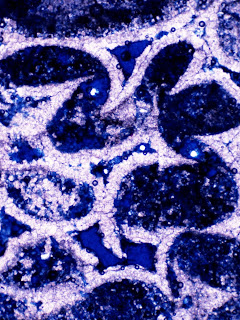
This rock has been through a lot. It began its existence in the Jurassic as a shifting sand shoal composed of tiny calcite spheres called ooids. The shoal was buried, and the ooids were cemented together with delicate crystals of calcium carbonate. The rock was now a limestone. Later, many of the ooids partially dissolved. Perhaps at about the same time, all of the limestone was turned to dolomite. The cement crystals became solid dolomite (solid bluish white curving areas in the picture), but the ooids still had a lot of holes in them (ovoid bluish or whitish areas). Also, some of the water-filled spaces among the original ooids had never been filled with cement (three dark blue areas with concave boundaries in the upper middle, middle, and lower middle of the picture). After a long time, thousands of feet of rock had buried the former shoal, and because it was so full of open spaces (dark blue) it was crushed.

Tuesday, March 10, 2020

031020c


Microcoprolites made by callianassid shrimp, Parafavreina ziczac, Jurassic Smackover Formation, south Alabama, thin-section photomicrographs, some of which are stained with Alizarin red S, which stains calcite pink, but does not stain dolomite. Samples from between 2 and 3 miles below the surface


 Partially dolomitized pellet packstone in which some pellets are preferentially dolomitized, well 1903, 11,770.9 feet.2 .5 mm wide

Pelmoldic pellet packstone (pores filled with light blue to very dark blue epoxy), well 1878, 11,789 feet, 2.5 mm wide.


Saturday, January 11, 2020

011120


"Trunk-to-tail" ooids in slightly compacted limestone, Jurassic Smackover Formation, Alabama, thin-section photomicrograph, stained with alizarin red S.

Friday, January 10, 2020

011020


Compound ooid, Smackover Formation, Jurassic, Alabama, thin-section photomicrograph.

Thursday, January 9, 2020

010920c


Stylolite (jagged black line) is an irregular three-dimensional pressure-dissolution surface in limestone. This one separates silty peloid packstone (pink, upper right) from mostly dolomitized limestone (left and bottom). Impermeable stylolite prevented dolomitizing fluids from reaching the upper-right portion of this thin-section. Black material along the stylolite is insoluble residue of limestone that has dissolved away. Jurassic Smackover Formation, subsurface of Alabama. Thin-section photomicrograph, 2.5 mm wide.

Thursday, June 13, 2019

061319b


Relict and dissolution porosity (blue) in mixed-particle grainstone (peloids [arrow], ooids, intraclasts), Jurassic Smackover Formation, Alabama, thin section photomicrograph, field-of-view 2.5 mm wide.

Tuesday, May 14, 2019

051419b


Mixed-particle grainstone cemented by well-developed pore-rimming calcite cement (probably altered from original marine aragonite cement). Deposited in a high-energy shallow marine environment. Jurassic Smackover Formation, Alabama. Stained with alizarin red S. Thin section photomicrograph. Field of view 2.5 mm wide.

Saturday, April 27, 2019

042719


Dolomitic limestone (gray area in the upper right) separated from limestone (red area in the lower left) by a stylolite, or pressure dissolution seam (black). Jurassic Smackover Formation, Alabama, thin section, 2.5 mm wide.

Friday, April 26, 2019

042619


Ooid grainstone (limestone) with prismatic pore-rimming calcite cement, probably marine. The centers of larger pores are open (white area in the upper part of the image). Jurassic Smackover Formation, Alabama, from nearly 3 miles below the surface, thin section. A tropical shallow-marine deposit.

Thursday, April 25, 2019

042519c


Small particles in limestone with a complex history. Ovoid particles, probably small pellets, were dissolved away, suggesting they consisted of aragonite (a chemically unstable carbonate mineral common in modern deposits but missing from many ancient ones). Before they dissolved the pallets were coated with a dark microcrystalline rind, often called a "micrite envelope," and formed by boring and encrusting microbes (widespread in modern tropical shallow-water environments). This material is commonly calcite, and it was preserved here. Later, the open space within the rinds was filled with calcite cement, a lot like that which filled in the spaces among the particles (light pink). This deposit, a peloidal grainstone, is typical of shallow water low to moderate energy tropical environments. Jurassic Smackover Formation, subsurface of Alabama, thin section, image 1 mm wide. Calcite stained pink with alizarin red S.

Friday, April 19, 2019

041919


Two examples of dedolomite (dolomite that has been dissolved) from the Jurassic Smackover Formation in Alabama. In the first image, some dolomite crystals are hollow. Blue indicates open pore space. In the second image, hollow dolomite crystals have been filled by calcite cement (pink, stained by Alizarin red S). These samples come from rocks buried several miles below the surface. Thin section photomicrographs, 1 mm across.

Thursday, April 18, 2019

041819


Grainstone composed almost exclusively of Parafavreina, a fecal pellet made by burrowing shrimp. This deposit is almost identical to modern accumulations of fecal pellets made by related burrowing-shrimp.This thin section was stained with Alizarin red S, staining calcite pink. White particles are quartz silt grains.. Light pink areas are calcite cement crystals filling original open spaces among the pellets. Jurassic Smackover Formation, Alabama, image 2.5 mm wide.

The photos of Parafavreina that I have been posting were taken in the process of preparing this scientific article:

Rindsberg, A. K., and Kopaska-Merkel, D. C., 2013 , Parafavreina ziczac isp. nov., a crustacean microcoprolite from the Upper Jurassic (Oxfordian) Smackover Formation of Alabama, U.S.A., Alabama Museum of Natural History Bulletin 31, v. 2. p. 74-93.

I have PDF copies of the article if anyone is interested.

Wednesday, April 17, 2019

041719d


Dolomite (gray) partially replacing calcite (pink) in a mixed-particle grainstone cemented with marine cement crystals (light pink). Particle in the center is a shrimp fecal pellet. 13,000 feet below the surface, Jurassic Smackover Formation, thin section photomicrograph, field of view 2.5 mm wide

Monday, April 15, 2019

041519c


Shrimp fecal pellets, some deformed by compaction against firmer specimens. Jurassic Smackover Fm, Alabama, thin section. Image 2.5 mm wide.

Friday, April 12, 2019

041219b


Bimodal pellet dolograinstone. Dolomitized pellets (gray) in matrix of altered calcite cement (red) with fine porosity within and among pellets (blue), Large pellet in the center of image (arrow) is Parafavreina, a shrimp fecal pellet. Red color is the result of staining with Alizarin red S. Jurassic Smackover Formation, Alabama, thin-section photomicrograph.

Thursday, April 11, 2019

041119b


Clotted thrombolite with large cylindrical fecal pellets of burrowing shrimp, Jurassic smackover formation, Alabama, thin-section photomicrograph.

Wednesday, April 10, 2019

041019c


Fecal-pellet grainstone dominated by the distinctive pellets of callianassid shrimp (the larger particles). Dolomitized Jurassic Smackover Formation, Alabama, thin-section photomicrograph. The pallets are trace fossils called Parafavreina ziczac. Generally, no fossils of the shrimp themselves are preserved, but their distribution is easily recognized from their pellets.

Tuesday, April 9, 2019

040919c


Fecal pellet of burrowing shrimp, Jurassic Smackover Formation, Alabama, thin-section photomicrograph.

Sunday, March 24, 2019

032419

Cross-laminated oolitic dolomitized grainstone, Jurassic, Smackover Formation, porous oil reservoir, North Choctaw Ridge Field, Alabama, five-centavo piece for scale.