Showing posts with label petrography. Show all posts
Thursday, January 21, 2021
012121d
Echinoderm fragment (large dark area with mottled interior like a fingerprint) with cement overgrowths (irregular extensions from the central area). Echinoderm ossicles are single crystals of calcite and they tend to be overgrown with cement in optical continuity with the original crystal. This object is photographed with crossed polarized light, and the specimen is oriented so the light canceled out the colors that would otherwise be observed. Thin-section photomicrograph, Mississippian, North Alabama, field of view 1 mm wide.
Thursday, May 21, 2020
052120b
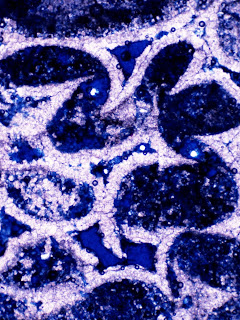
This rock has been through a lot. It began its existence in the Jurassic as a shifting sand shoal composed of tiny calcite spheres called ooids. The shoal was buried, and the ooids were cemented together with delicate crystals of calcium carbonate. The rock was now a limestone. Later, many of the ooids partially dissolved. Perhaps at about the same time, all of the limestone was turned to dolomite. The cement crystals became solid dolomite (solid bluish white curving areas in the picture), but the ooids still had a lot of holes in them (ovoid bluish or whitish areas). Also, some of the water-filled spaces among the original ooids had never been filled with cement (three dark blue areas with concave boundaries in the upper middle, middle, and lower middle of the picture). After a long time, thousands of feet of rock had buried the former shoal, and because it was so full of open spaces (dark blue) it was crushed.
Tuesday, March 24, 2020
032420d
Thin sections of a Mississippian fossil hash from north Alabama, technically an echinodermal bryozoan grainstone (Dunham classification). All images are 2.5 mm wide.
Bryozoan fragments, with a few echinoderm ossicles and brachiopod fragments.
Echinoid spine in bryozoan hash.
Bryozoan grainstone.
Large brachiopod shell fragment in bryozoan grainstone.
Large and small echinoderm ossicles in bryozoan-dominated grainstone.
Friday, August 30, 2019
083019b
Calcite cement (pale pink) dissolving feldspar and quartz in a very fine sandstone, Rodessa Formation, Citronelle oil Field, Alabama, about 11,000 feet below the surface, thin section, scale bar 100 micrometers, crossed polarizers.
Thursday, August 29, 2019
082919c
Thin section photomicrograph of silty sandstone containing mica (bright particle in the center). Rodessa Formation in Citronelle oil Field, Alabama, scale bar 25 micrometers. Crossed polarizers. About 11,000 feet below the surface.
Wednesday, October 5, 2016
A ripple, close-up and personal
Silty micaceous sandstone, cross laminated, crossed polarizers, muscovite and biotite mica. From 2 miles below the surface.
Thursday, September 1, 2016
Sandstone in thin section
Poorly sorted sandstone cemented by calcite (pink).
Muscovite (mica) in sandstone.
Both from the Cretaceous Rodessa Formation in Citronelle oil field, Alabama. About 2 miles below the surface. Both photos taken using crossed polarized light.
Tuesday, August 16, 2016
A very poorly sorted sandstone
A sample of beach sand would consist of very round particles all more or less the same size. This one was not deposited on a beach
Monday, August 15, 2016
A very old skeleton
What used to be a hale and healthy feldspar sand grain is now hardly a shadow of its former self. Blue is open space. Note the scale.
Friday, August 5, 2016
Wednesday, August 3, 2016
Sandstone – up close and personal
Scale is one quarter of a millimeter. Photographed with cross-polarized light, which gives different minerals different colors. Relatively large chunk of clay (center) in a sandstone matrix.
Cretaceous, Rodessa Formation, Citronelle oil field, Alabama, about 2 miles below the surface.
Monday, May 23, 2016
Friday, August 1, 2014
You like these rock pictures don't you?
Friday, June 13, 2014
Subscribe to:
Posts (Atom)