Showing posts with label dolomite. Show all posts

Thursday, May 21, 2020

052120b


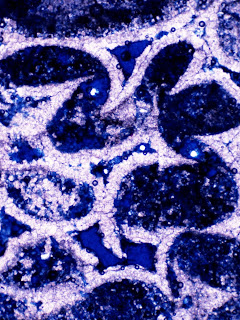
This rock has been through a lot. It began its existence in the Jurassic as a shifting sand shoal composed of tiny calcite spheres called ooids. The shoal was buried, and the ooids were cemented together with delicate crystals of calcium carbonate. The rock was now a limestone. Later, many of the ooids partially dissolved. Perhaps at about the same time, all of the limestone was turned to dolomite. The cement crystals became solid dolomite (solid bluish white curving areas in the picture), but the ooids still had a lot of holes in them (ovoid bluish or whitish areas). Also, some of the water-filled spaces among the original ooids had never been filled with cement (three dark blue areas with concave boundaries in the upper middle, middle, and lower middle of the picture). After a long time, thousands of feet of rock had buried the former shoal, and because it was so full of open spaces (dark blue) it was crushed.

Tuesday, March 10, 2020

031020c


Microcoprolites made by callianassid shrimp, Parafavreina ziczac, Jurassic Smackover Formation, south Alabama, thin-section photomicrographs, some of which are stained with Alizarin red S, which stains calcite pink, but does not stain dolomite. Samples from between 2 and 3 miles below the surface


 Partially dolomitized pellet packstone in which some pellets are preferentially dolomitized, well 1903, 11,770.9 feet.2 .5 mm wide

Pelmoldic pellet packstone (pores filled with light blue to very dark blue epoxy), well 1878, 11,789 feet, 2.5 mm wide.


Thursday, January 9, 2020

010920c


Stylolite (jagged black line) is an irregular three-dimensional pressure-dissolution surface in limestone. This one separates silty peloid packstone (pink, upper right) from mostly dolomitized limestone (left and bottom). Impermeable stylolite prevented dolomitizing fluids from reaching the upper-right portion of this thin-section. Black material along the stylolite is insoluble residue of limestone that has dissolved away. Jurassic Smackover Formation, subsurface of Alabama. Thin-section photomicrograph, 2.5 mm wide.

Thursday, May 23, 2019

052319d


Dolomitized limestone (pink=calcite stained with alizarin red S; white and gray= dolomite), early dolomite formed under exposure surface at top of upward-shoaling cycle, Mississippian (Serpukhovian, Chesterian) Bangor Limestone, a few meters above a carbonate mound, near Moulton Alabama, thin-section photomicrograph,

Saturday, April 27, 2019

042719


Dolomitic limestone (gray area in the upper right) separated from limestone (red area in the lower left) by a stylolite, or pressure dissolution seam (black). Jurassic Smackover Formation, Alabama, thin section, 2.5 mm wide.

Friday, April 19, 2019

041919


Two examples of dedolomite (dolomite that has been dissolved) from the Jurassic Smackover Formation in Alabama. In the first image, some dolomite crystals are hollow. Blue indicates open pore space. In the second image, hollow dolomite crystals have been filled by calcite cement (pink, stained by Alizarin red S). These samples come from rocks buried several miles below the surface. Thin section photomicrographs, 1 mm across.

Wednesday, April 17, 2019

041719d


Dolomite (gray) partially replacing calcite (pink) in a mixed-particle grainstone cemented with marine cement crystals (light pink). Particle in the center is a shrimp fecal pellet. 13,000 feet below the surface, Jurassic Smackover Formation, thin section photomicrograph, field of view 2.5 mm wide

Friday, April 12, 2019

041219b


Bimodal pellet dolograinstone. Dolomitized pellets (gray) in matrix of altered calcite cement (red) with fine porosity within and among pellets (blue), Large pellet in the center of image (arrow) is Parafavreina, a shrimp fecal pellet. Red color is the result of staining with Alizarin red S. Jurassic Smackover Formation, Alabama, thin-section photomicrograph.

Sunday, March 31, 2019

033119


Dolomite (gray and white); this rock was once very porous, but all the pore space has been filled with calcite cement (stained pink with Alizarin red S), note partial replacement of rhombic dolomite crystals with calcite; dolostone of Knox Group, Mississippi, thin-section photomicrograph.

Saturday, March 30, 2019

033019


Baroque dolomite growing into void within dolostone of the Knox Group, Mississippi, thin-section photomicrograph.

Thursday, March 28, 2019

032819b


Dolomite (white and gray) with a small void lined with dead oil (bitumen; black) and filled with calcite cement, stained pink with Alizarin red S. Cambrian-Ordovician Knox Group, Maben Field, Mississippi. Thin-section photomicrograph.

Monday, March 25, 2019

032519


Calcite (bright red) and partially dolomitized limestone (dark red with light-colored specks of dolomite), partially silicified (very bright white and gray areas), Mississippian Bangor Limestone, Haletown Tennessee, thin-section photomicrograph.

Sunday, March 24, 2019

032419

Cross-laminated oolitic dolomitized grainstone, Jurassic, Smackover Formation, porous oil reservoir, North Choctaw Ridge Field, Alabama, five-centavo piece for scale.

Saturday, March 23, 2019

032319


Limestone (calcite, stained red with alizarin red S), partially replaced by dolomite (white and gray), which has in turn been partially replaced by calcite, indicated by the worm-eaten outlines of the dolomite crystals. Thin-section photomicrograph. Jurassic Smackover Formation, West Appleton Field, Alabama.

Tuesday, March 19, 2019

031919d


Dolomite crystals (white and gray) that have replaced a pre-existing limestone fabric. Calcite cement crystals (red) have filled in all the open spaces left by the dolomite, and partially dissolved some of the dolomite crystals. Jurassic Smackover Formation, Alabama, thin-section photomicrograph.

031919


Partially dolomitized ooid grainstone. Some ooid laminae, and some cement generations, are still calcite. Bright white objects are quartz sand particles. Jurassic Smackover Formation, Alabama, thin-section photomicrograph, stained with Alizarin Red S.

Tuesday, March 12, 2019

031219


Crinoid columnal (center of image) in partially dolomitized skeletal packstone, Bangor Limestone, Mississippian, Alabama. Thin-section photomicrograph stained with Alizarin Red S, which stains calcite pink.

Monday, March 11, 2019

031119b


Fragment of rugose coral embedded in dolomitized lime-mud matrix. Bangor Limestone, Mississippian, Alabama. Thin section photomicrograph stained with Alizarin Red S, which stains calcite pink.

Friday, March 8, 2019

030819c


Fenestrate bryozoan in dolomitic limestone, carbonate mound, Bangor Limestone, Mississippian, Alabama. Thin-section photomicrograph stayed with Alizarin red S.

Wednesday, March 6, 2019

030619b


Anhydrite replacing limestone and filling fracture in Smackover Formation, south Alabama. Thin section photomicrograph. Image about 1 mm across.


Light-colored dolomite, which partially replaced red-stained limestone, is being in turn replaced by limestone. Smackover Formation, south Alabama. Thin section photomicrograph. Image about 1 mm across.


Wormy-looking sponge in the upper part of image, Smackover Formation, south Alabama Slabbed and polished core. Core 4 inches wide.